Shoe Tying Tips for Kids Who Struggle: Strategies That Actually Help
Nov 03, 2026
For those of you with kiddos who just can't seem to learn how to tie their shoe laces...this blog post is for you! I've been there and understand the challenge that this can bring to a child's self-esteem. So, if your child is really struggling to tie their shoelaces, and they are hitting a wall of frustration despite your best efforts and theirs, you are not alone. Shoe tying is a complex, multi-step motor task that requires coordination between both hands, visual processing, sequencing, and finger strength—all working together at once. This can be tricky for any child! For children with Developmental Coordination Disorder (DCD/dyspraxia), motor planning challenges, or fine motor delays, it's even harder.
When things don't come easily to our kids it can lead to frustration. Frustration isn't necessarily a bad thing. Our kids need to learn how to tolerate frustration when learning a new skill. Frustration is normal. But, extreme frustration can also lead to a shut down in learning especially if a child has additional challenges where some of their systems don’t sync as easily. Intense frustration and repeated "failure" to learn something new can lead to avoidance, irritability, feelings of being "stupid", embarrassment, comparison, and even shame. Your child may think, “Why is this so hard for me when it seems easy for everyone else?”

Our parent hearts want to step in and fix it! So, we try to make things easier by avoiding shoe tying altogether. We grab the slip on shoes or bungee laces for our child. We tie their shoes for them with double knots so they hopefully won't come loose on the playground. We cross our fingers that a teacher or friend will help out and not comment, "Don't you know how to tie yet?"
And, while there is nothing wrong with these supports along the way, it's still our job to help our child learn new skills even when there is frustration. So, how can we step in to help them succeed? I'm going to walk you through some simple steps that have helped in my own home along with links to some resources and items to help support your child as they learn. You've got this...and so will your child!

First, Let’s Reframe What This Skill Actually Requires
Shoe tying is not just about learning steps. It's complicated!
It relies on:
● Bilateral coordination (both hands working together)
● Fine motor strength and dexterity
● Motor planning and sequencing
● Visual-motor integration
● Tactile awareness and sensory processing
That’s a lot! The more that we can break this complex task into smaller parts and practice those parts, gradually putting them together, the more likely our child is to have success. This builds confidence. If your child is struggling, it isn't because they aren't motivated enough, it's because they don't yet have the skills they need to succeed.
So, how do we help our kids succeed? Before we talk strategies, I want to reinforce that children learn new skills best when they feel safe. Your child can learn this skill, but they need the opportunity to practice without pressure. They need to be able to "fail" at it in a safe setting without the pressure of performance. This means that the best time to learn isn't when you are running late and rushing out the door. Kids often get stuck in their learning process, not because they can’t learn, but because they’re being asked to "perform" before they have mastered the skill.
While They’re Learning… Supporting Them Is Not “Cheating”
There is absolutely nothing wrong with using supportive tools while your child is learning.
● Slip-on shoes
● Velcro closures
● Elastic/bungee laces
These are what we call scaffolds. They protect your child’s confidence while their brain and body are still building the skill. (And yes—I’ll be linking some of my favorite options in this post so you can easily find ones that work for your child.) Now, let's get into the actual strategies!!!
Practical, OT-Informed Strategies That Actually Help
These are strategies that I've learned from occupational therapy principles and motor learning research, and which I've adapted for real life in my own home.
1. Practice Off the Body First
One of the biggest barriers? The angle.
When a child is trying to tie a shoe on their own foot:
● Their hands are rotated awkwardly
● Their visual field is reversed
● Their posture is unstable
Start with:
● A shoe in their lap
● A shoe on a table
● A shoe-tying practice board
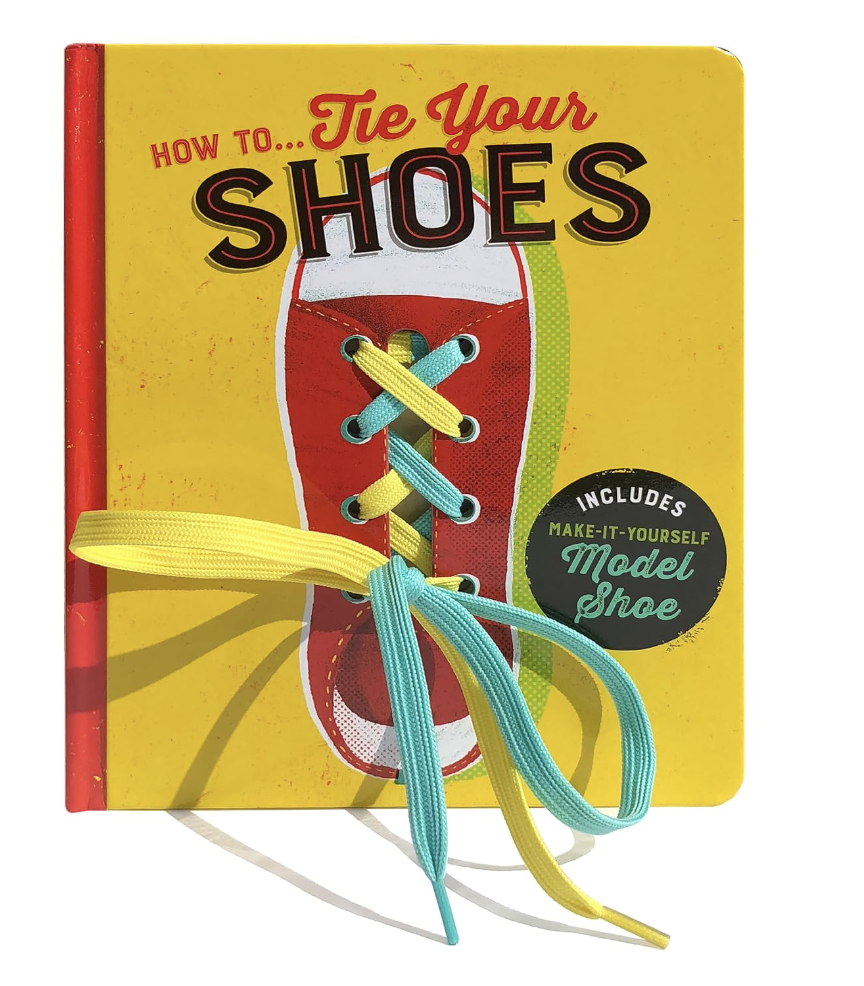
This allows the brain to learn the sequence without the added motor complexity. Our OT actually introduced me to this super cool book that allows your child to "build a shoe" and then walks them through different steps of tying. It comes with a fun multicolored lace.
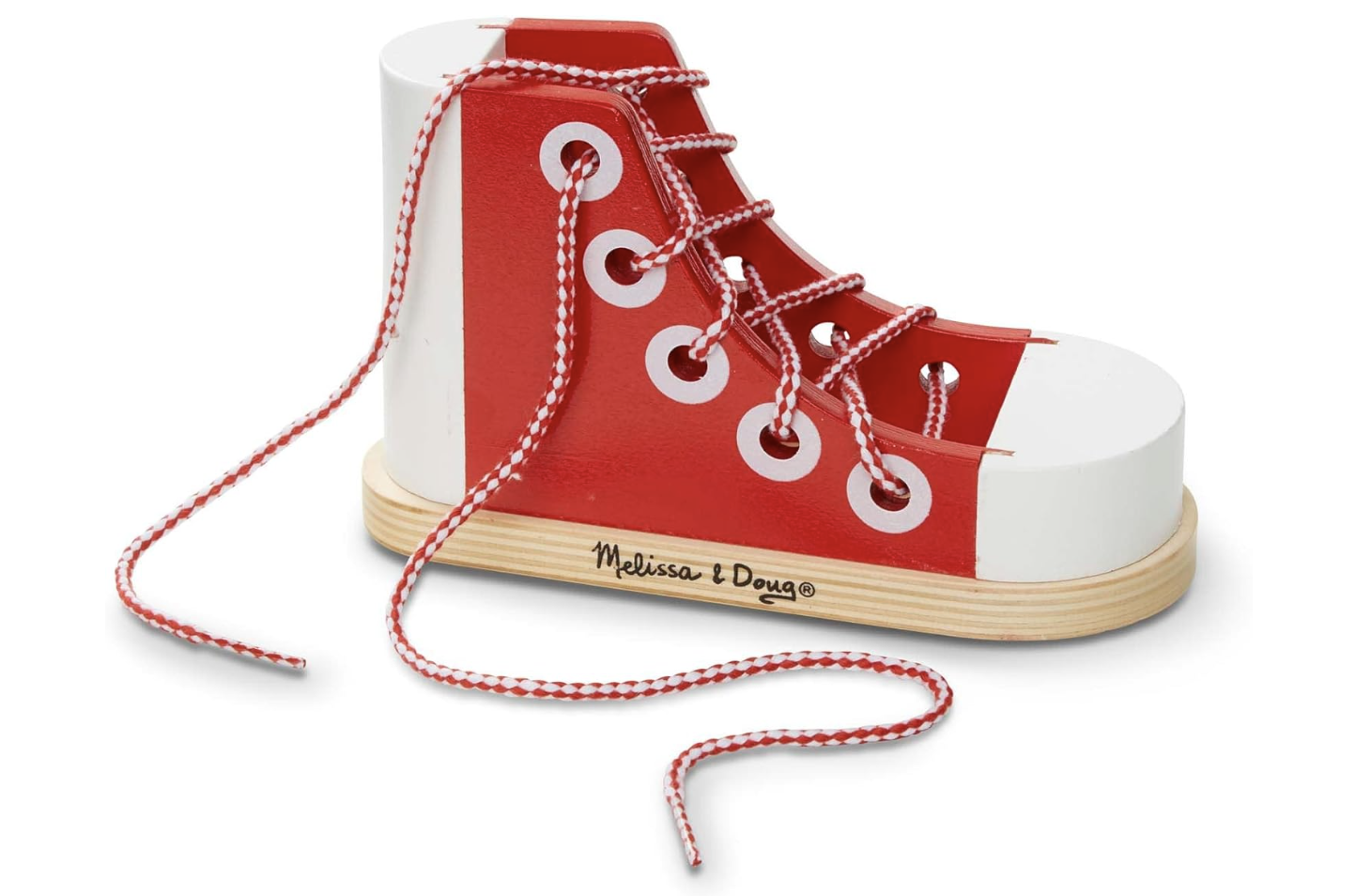
Or, you could try a toy shoe like this one from Melissa and Doug.
2. Use Backward Chaining
This is a gold-standard OT strategy.
Instead of teaching all the steps at once:
● You do most of the steps
● Your child completes the last step
Then gradually:
● They complete the last 2 steps
● Then the last 3 steps
This builds success immediately and reinforces confidence. 
3. Use Two Different Colored Laces
This is simple, but incredibly effective.
Children with motor planning and left/right confusion benefit from visual clarity.
Two colors help them:
● Track which lace is which
● Follow directions more easily
● Reduce cognitive load
This is a commonly recommended OT strategy for teaching sequencing skills. 
Here's the LINK for the multicolored laces we tried in my own home!

4. Break It Down (Really Break It Down)
Instead of “tie your shoes,” think:
● Cross
● Pull tight
● Make one loop
● Wrap
● Push through
● Pull tight
Children with coordination challenges benefit from "task analysis". This is just a fancy phrase for breaking a complex skill into small, teachable parts. Don't leave them to figure this out on their own even if you have shown them a million times. Get down to their level and body double it with them. Walk them through the steps each time, praising their effort as they try.
5. Practice When Calm, Not When Rushed
This one matters more than we realize. If you're anything like me, you are constantly trying to get out the door in a hurry or transition from one place to the next. My kids often kick their shoes off in the car and since we don't wear shoes in our home, we are constantly putting shoes back on. But, learning under pressure isn't effective.
Shoe tying at:
● The door before school
● The playground
● Gym class
…is the worst time to learn.
Instead:
● Practice during calm moments
● Keep it playful
● Stop before frustration peaks
Motor learning improves with repetition in low-stress environments. 
6. Build the “Pre-Skills”
If your child is really struggling, zoom out.
Shoe tying requires foundational skills like:
● Hand strength
● Finger isolation
● Bilateral coordination
Helpful activities:
● Playdough or putty
● Beading
● Cutting with scissors
● Lego or small manipulatives
These aren’t random. They directly support the underlying motor system needed for tying. 
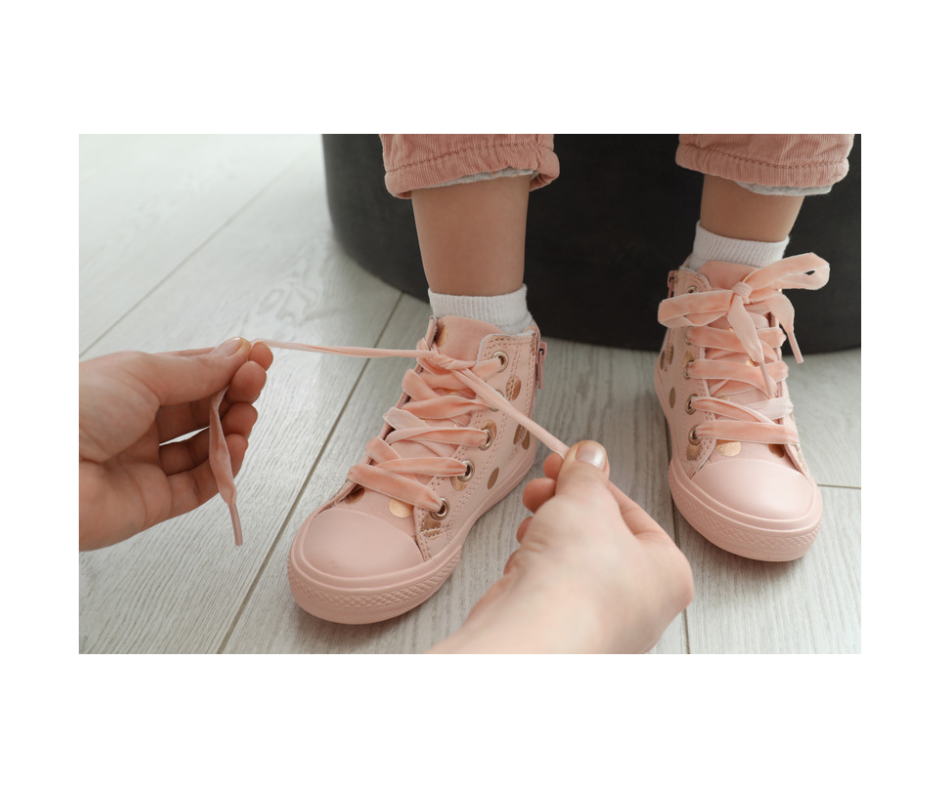
7. Try Different Methods
Not all brains learn the same sequence.
Options include:
● Bunny ears method
● Loop-swoop-pull
● One-loop methods
Some children need a different motor pattern to make it click.
8. Use Adaptive Options (Like Bungee Laces)
And finally, yes, let’s talk about one of the easiest wins:
Elastic or bungee laces.
These:
● Turn lace-up shoes into slip-ons
● Maintain independence
● Remove the social pressure
● Let your child focus on being a kid
There are many types (toggle locks, stretch laces, no-tie systems), and I’ll be sharing my favorites—with links—so you can find ones that work for your child’s shoes and preferences.
What to Say While Your Child Is Learning
When a child is learning to tie their shoes, especially with fine motor or coordination challenges, how we respond matters just as much as how we teach the skill. Here are a few simple, supportive scripts you can use:
Before you start:
● “We’re just practicing—you don’t have to get it perfect.”
● “We’ll take this one step at a time.”
During practice:
● “Let’s do this step together.”
● “You’re working really hard on this.”
● “That part is tricky—your brain is learning something new.”
When frustration shows up:
● “I can see this is frustrating.”
● “This is a hard skill—it takes time.”
● “Let’s take a break and come back to it later.”
After practice:
● “I’m proud of how you kept trying.”
● “You didn’t give up—that matters.”
● “We’ll keep practicing, and it will get easier.”
This shift from pressure to support can make a big difference because kids learn best when they feel safe, not rushed.
Shoe tying is a milestone, but it’s not a measure of your child’s intelligence, effort, or potential. It’s simply a motor skill. And like all motor skills, it develops at different rates, with different supports, and in different ways. Research consistently shows that with intentional, supportive practice, children can build these skills over time and gain independence in daily activities. So, if this is something your child is struggling with right now, you are not behind. You are in the middle of a time where your child needs support right where they are at! You can safeguard their confidence, build trust and connection, and bolster their self-esteem by using the right scaffolding techniques. You've got this!
Parenting alongside you,
Dr. Emma & the Aparently Parenting Team
SUBSCRIBE FOR FREE PARENTING RESOURCES
We know you're busy! So, we'll make sure to only send the IMPORTANT PARENTING stuff!!
We hate SPAM. We will never sell your information, for any reason.
